Entries from June 2009 ↓

Currie Technologies 6 pin Diaganostic throttle pin-out

I purchased a surplus Currie Technologies “Diagnostic” throttle. (Which includes 3 LED’s labeled as 1/3, 2/3 and full charge indicators) It has a six pin (7 cable) connector with no pin-out diagram.
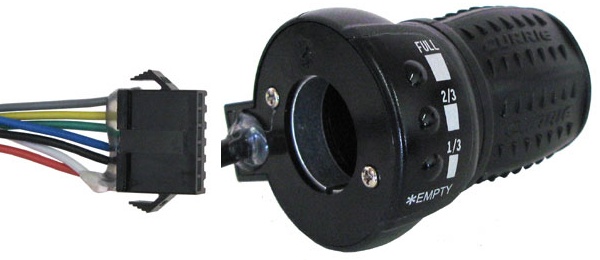
Currie Technologies diagnostic throttle

Currie Technologies diagnostic throttle

After opening it up, it appears that the blue, black, and red wires are connected to the throttle sensor itself, while the other four wires (White, Gray, Yellow, Green) connect to the LED circuit board.

The pin-out ordering is as follows, from the bottom of my picture up:

  1. Red/White (Throttle/LED, sharing a pin, + voltage)
  2. Black (to throttle, I assume Ground)
  3. Blue (from throttle, I assume signal)
  4. Green (Full LED)
  5. Yellow (2/3 full LED)
  6. Gray (1/3 full LED)

I connected the Red/Black/Blue wires to a motor speed controller that had a 3 wire throttle connection (matching them up to the Red/Black/Green wires from the controller) and it worked great!

The LED pin-out is as follows:
White (positive / Vcc)
Gray – 1/3 empty LED
Yellow – 2/3 full LED
Green – Full LED

Note that I was able to get the LED’s to light up with a 3V source, but I believe their forward voltage is less than 3V and you should use a current limited supply so that you do not burn the LED’s out.

Electric Scooter Power Usage Details

I purchased a used Navajo Turbo Z 24volt electric scooter. The person I bought it from had installed two brand new 12V 7.0Ah batteries, similar to the battery in this data sheet. Note that because the scooter will discharge the batteries in less than an hour, the pack’s usable capacity is closer to 4Ah. Because the batteries are sealed lead-acid, they are heavy, approximately 6lbs each, and the pair make up approximately 35% of the scooter’s 34lb total weight. (Most of the rest of the weight comes from the hefty all-steel frame, and the 5lb 200-watt motor.)
Continue reading →

US GSM Bands (T-Mobile, AT&T)

AT&T and T-Mobile are the two main providers (in the USA) who provide GSM service. Below are the main cellular bands they use.

AT&T:
GSM: 850 and 1900
3G: 850 and 1900

T-Mobile:
GSM 1900
3G: 1700 (AWS) and 2100MHz

GSM bands not supported in the USA, but active in other countries: 900 and 1800.

Internationally, you may need the 900 and 1800 bands, especially in Europe and Asia (many south American countries work on the 1900 GSM band). If you have a “quad-band” phone it will work everywhere.

Sometimes these bands are called by acronyms instead of frequencies:
UMTS: 2100
PCS: 1900
DCS: 1800
AWS: 1700 (or simply AWS)

The advanced wireless system is a new block of bandwidth that has been opened up for use in the USA. AWS Overlaps with UMTS and DCS (1700/1800 and 2100) The convention appears to be labeling AWS with the number 1700, because 1800 and 2100 are already used to indicate other things.

Different channels on different tuners (MythTV)

My SiliconDust HD HomeRun has a relatively good HD tuner, but it’s not quite as good as the built in tuner on my TV at picking up stations that are extremely strong and have multi-path reception problems. Although the signal My MythTV box reception of Fox TV would intermittently cut out as the SNR would drop too low to enable reception (even though, or, because the power level was pegged at 100%).

I purchased a Skywalker 16db attenuator, and it successfully lowered the signal strength of the (overpowered) Fox channel so that my HD HomeRun’s tuner chip could receive it with an acceptable SNR and no dropouts.

The only problem with attenuating my signal was that one of the two PBS channels (8, GPB-HD) was too weak to be picked up through the attenuator.
Continue reading →