J1772 to 120 volt opportunity charging auto-switchover

My truck’s charge controller supports the J1772 protocol, and I have added a J1772 inlet I took out of the same salvage Nissan leaf that provided my LiIon battery pack.

I added the J1772 port, the “start charging” button, and a rotary switch to select between different charging profiles, as well as a 120 volt, 15 Amp RV inlet behind a flip up license plate.

When you have one charging inlet, things are simple and safe. When you have more than one, things can get complicated. In my case, I wanted to use the same charger(s) with both inlets. But I shouldn’t just wire them both up in parallel, because that would mean that the (male pins on the) RV inlet would be energized at 240 volts when charging via the J1772 plug, and it wouldn’t be good for somebody to reach in and touch them. Also, if somebody were to try and plug in the J1772 AND a 120 volt extension cable at the same time, they would be connecting a HOT (from the J1772) line directly to the Neutral line on the 120 volts (causing a short circuit). [Having the J1772 inlet energized with 120 volts is also undesirable, although slightly less dangerous, as the J1772 inlet is designed to be “finger safe”.]

Continue reading

How to convert a Denford / ScanTek 2000 Micromill to LinuxCNC / Mach3 control: Part 3 — Spindle Motor Control

In part 1 of this series I got the stepper motors for the 3 axes moving. In part 2 I hooked up the home and E-Stop switches. In this post I will describe getting the spindle motor to turn on (and off!) controlled via the parallel port break out card (I’m using Pin 1).

You can watch the video here, or read the text and see the photos below:

To enable the spindle motor, two things have to be done. First, the Spindle Go Relay (SGR) must be turned on, which provides 120 volts AC to the spindle driver board. Second, the spindle driver board input needs a 10 volt input to turn on the output (to the spindle motor) at full blast. The photos below are of my Dispatch Date 2005 mill, but other mills from Denford are similar in their general operation. [If you have an earlier dispatch date mill, you may have a DIN rail of relays mounted individually instead of this custom PCB of relays. Check out this post for a few photos and info about the SGR in that situation.]
Continue reading

How to convert a Denford / ScanTek 2000 Micromill to LinuxCNC / Mach3 control: Part 2 — Home switches & E-Stop

Part 1 told how to make your computer output commands to the 3 stepper motors controlling the X,Y,Z axes of the mill so that you could jog them around under computer control.

This post deals with getting input from the switches on the mill to your computer.

I am interested in getting input from 4 switches on the mill. First, the Emergency Stop button on the front panel is great to have operational!

estop

Continue reading

How to convert a Denford / ScanTek 2000 Micromill to LinuxCNC / Mach3 control: Part 1 – 3 Axis control

How to convert a Denford   / ScanTek 2000 Micromill to LinuxCNC / Mach3 control

Part 1 – 3 Axis control
Video here, details below


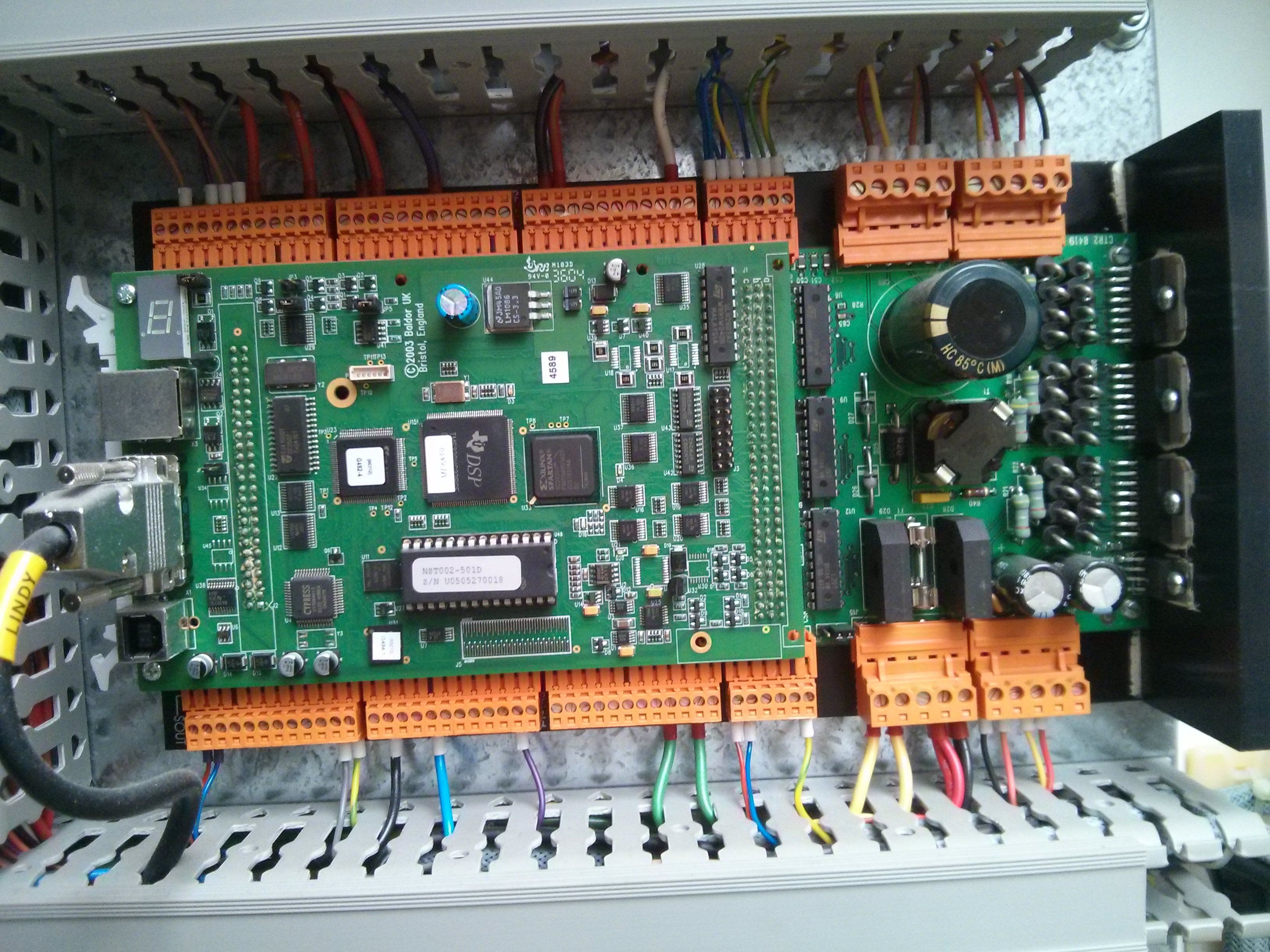
My ScanTek 2000 ScanMill (A re-branded Denford Micromill 2000) has a dispatch date of 2005, which means that it’s main controller is a Baldor NextMoveST card. This card supports USB as well as RS232 control signals, and runs a custom (MINT) programming language that can offload machine control from the host computer.

Baldor NextMoveST

You can actually download the MintNC development tool from the Baldor website that allows you to upload custom Mint programs to the card, and could make it (for example) do some simple operations offline with no driving computer. However, I am not interested in writing Mint code to interpret g-code, so I’m going to set it up so that LinuxCNC (or Mach3) can control it via a parallel printer port.
Continue reading

Defeating the keyswitch on my ScanTek 2000 (denford Micromill)

keyswitch_removed

I was trying to figure out what the series of   E 5 L- o P letters on the 7 segment display was trying to tell me ( E, S   o, L   and P are all valid messages, but the L combined with a dash was throwing me. Turns out the 5 was an S and the L- was a T….) A sharp eyed viewer (who wasn’t constrained by having a table of all the possible error codes) commented that it looked like it was spelling out “EStoP” or Emergency Stop, which wasn’t listed in the table.   Sure enough, it turns out that the front panel key switch generates an E-STOP (just as the main E-Stop switch does).

After defeating the keyswitch, the machine gave a single “dash” – on the display, which is a standard “Servo Power Off” state. Continue reading

ScanTek (Denford) MicroMill 2000 – Initial powerup and front panel controls

IMG_20160108_141043

This is a ScanTek 2000, a rebranded Denford Micromill 2000 that has a CNC controlled Sherline mill in a nice steel enclosure with some fancy CNC electronics. According to the nameplate, it was dispatched in October 2005, so a relatively newer model.

They are designed for technical schools and shop classes to teach students the fundamentals of CNC machining without having to have a really large CNC mill. Although the Sherline Mill inside is relatively small, it is still a serious mill and can be very precise and even mill mild steel.   I purchased mine surplus, and it unfortunately did not come with the key for the front panel power switch, or the software to drive the mill. My first goal was to see if I could get it to turn on.

front_panel_only

Continue reading

Melted fuse leg

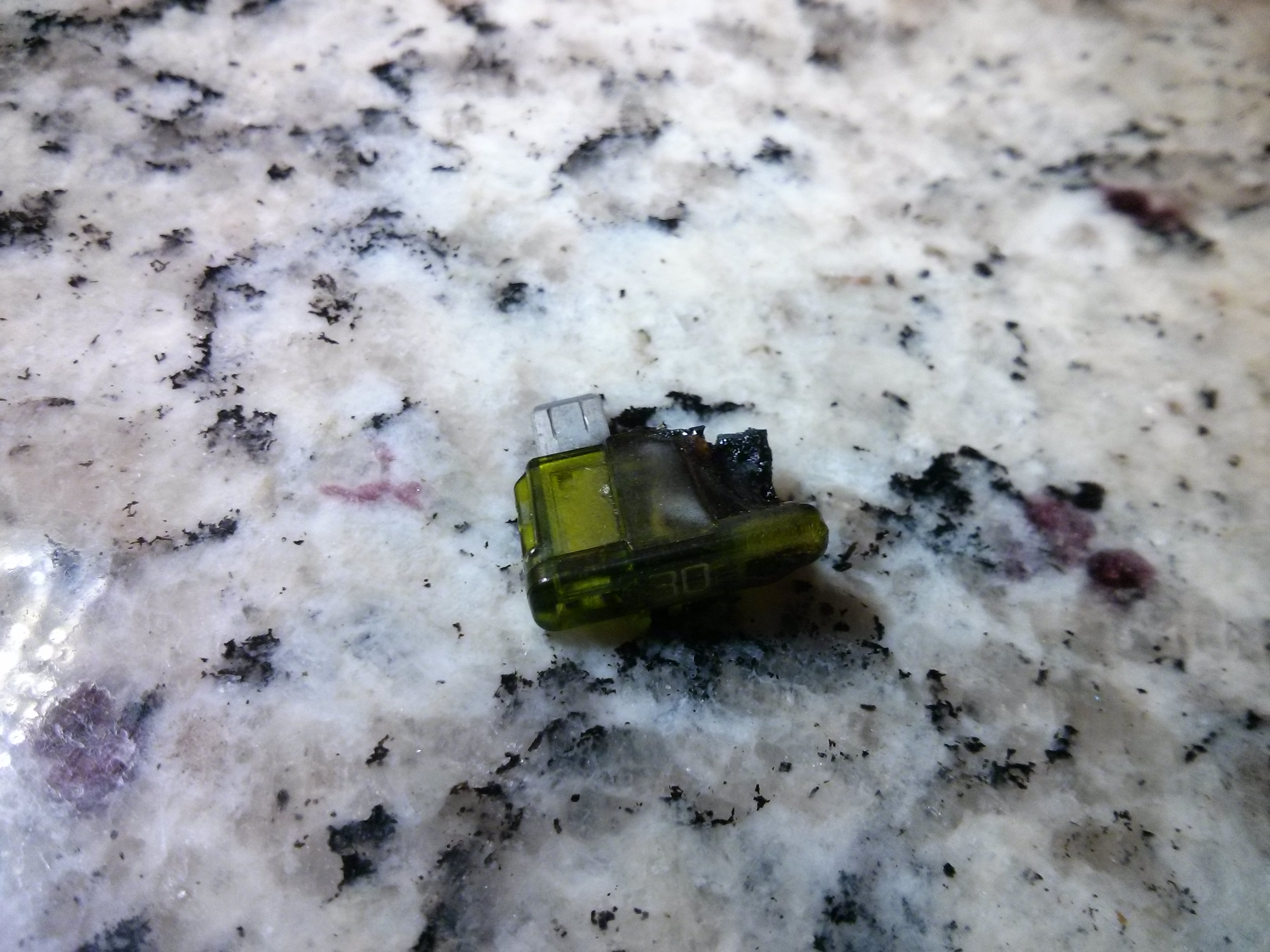
Driving down the road today I smelled a plastic/electrical burning smell, which caused me to stop the truck and run around it quickly checking for any problems in my new Lemelted_fuseaf modules. After verifying that they were not on fire, smoking, bulging, or even warm, I sniffed around the truck and decided the smell was emanating from under the hood, and eventually traced it to near my DC-2-DC converter (which keeps my 12 volt accessory battery charged up from the main 128 volt pack, replacing an alternator on an ICE vehicle). When I checked on the accessory battery voltage, it was 13.8 volts instead of the 14.5 volts that normally shows up when the DC-2-DC converter is working, so I thought that I had blown that out.

As it turns out, the only thing that had melted was the leg of the 30 amp 12 volt fumelted_fuse_holderse I have between my DC-2-DC converter and my 12 volt accessory battery. Note: the fuse did NOT blow. One leg of the fuse melted into the holder, melting one side of the fuse and the plastic holder. The DC-2-DC converter was still working (but no longer connected to the 12 volt accessory system), and all of the 12 volt components were working fine on the redundant battery power.

At the time this happened I had the headlights and fan blower on, so the 12 volt load was about as high as it gets, but I’d been driving around like that for several years without the fuse or holder giving me any problems.   The only explanation I can come up with is that the process of moving wires around for the Leaf Module install loosened up the fuse in the holder and caused a loose connection, and the added resistance heated the connection up until it failed. (Although the fuse looked to be fully inserted into the holder even after it melted…)

I will have to replace the fuse and holder, and I’ll probably zip tie the new fuse into the holder when I replace it.

Thunderstruck Motors dual TSM2500 & EVCC charger package

As part of the Li-Ion battery upgrade procedure, I needed a charger that could be programmed to work with the Li-Ion modules and my BMS loop system.   I decided on the EVCC (Electric Vehicle Charge Controller) from Thunderstruck Motors paired up with dual TSM2500 ( a.k.a CH4100) chargers. The total system cost just under $1200 shipped, so it was quite economical for a 4.2 kW system. The trade off for the low cost is that you have to wire both chargers up to the battery pack and the J1772 inlet in parallel, requiring you to make two sets of Y adapter cables. Theoretically the EVCC can control up to 4 of the inexpensive TSM2500 chargers, but I think wiring up two is about the most I would want to do, and if you want a high power charger it would probably be better to purchase one or two PFC-3000 or PFC-4000 chargers (which also interface to the EVCC).
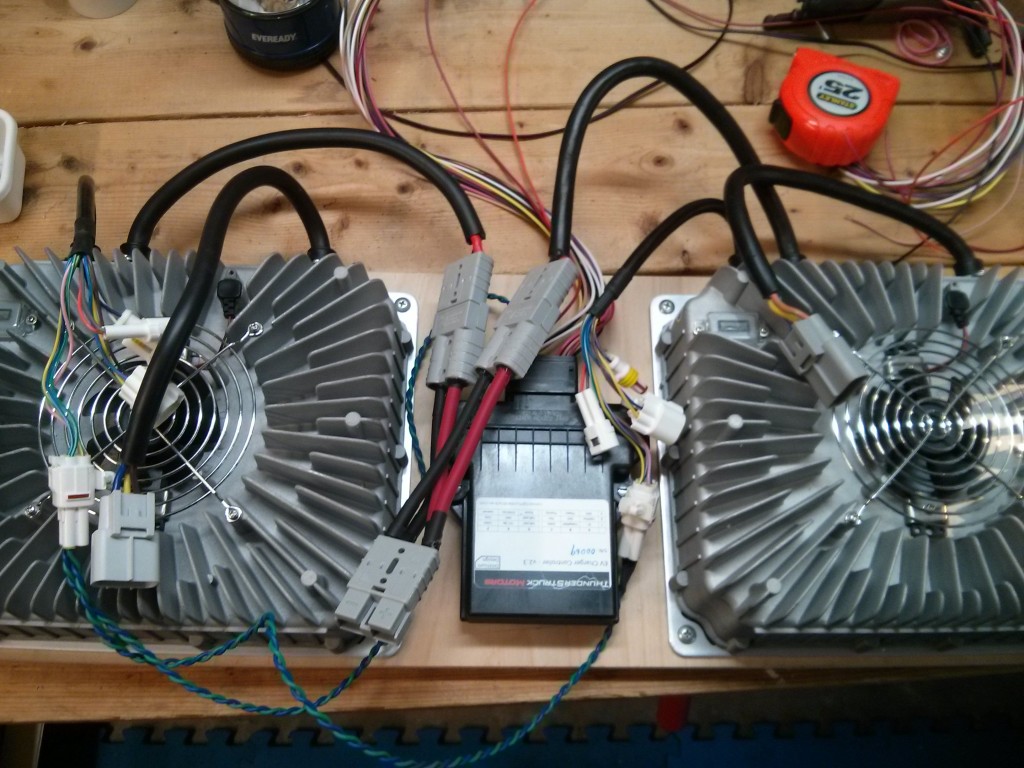
06_y_in_place

I really like the EVCC, as it supports the J1772 protocol and can monitor my mini-BMS loop both for charging as well as for a low voltage warning when running. It also supports the ability to disable the EV when the J1772 plug is inserted (drive away protection).

The first one I received had a few software/firmware bugs that required me to send it back for a re-flash (one of the bugs made it so that the bootloader couldn’t re-flash it in the field!), but after I received the upgraded module it has been working well and I haven’t noticed any more bugs.

I have it set up with a single charge profile so far, but it actually supports 4 charge profiles that can be user selectable via a resistor network on a rotary switch. I have installed the hardware to select different charging profiles and will be programming them in the future.

The two chargers, EVCC and a few relays (for switching between the J1772 port and 120 volt RV inlet) are attached to a piece of wood that fits into the former front battery bay of my S-10 conversion. Althought I COULD fit two more chargers in there, space would get tight, the wiring would be (more) messy, and I’d be worried about the airflow and cooling. As it is, I’ve found that 4.2 kW charging is plenty fast for me. I can take a 16 mile trip, which is much longer than my daily commute, and be recharged in 141 minutes.
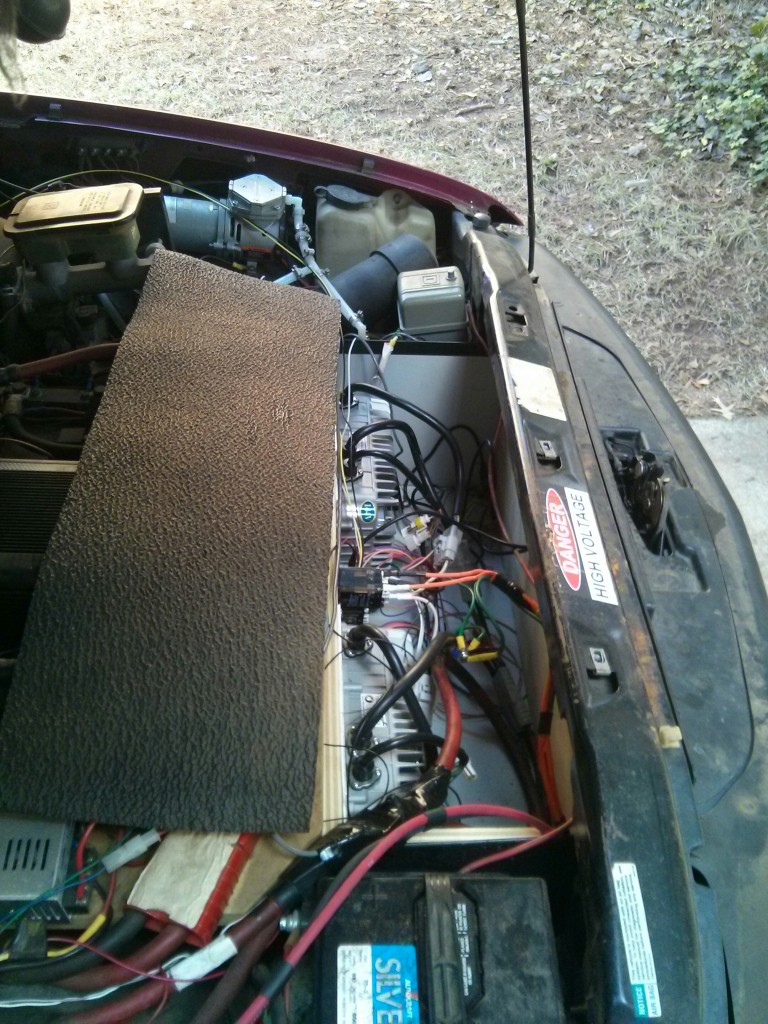
charging_bay


I found a Chinese website selling the same charger with a different model number, and their technical specifications were slightly better, so I made a PDF out of the website which you can access here: CH4100-series_more_info

Lead Acid to Nissan Leaf Pack upgrade process

The main process of upgrading my S-10 Electric Conversion pickup truck to use the Salvage Nissan Leaf LiIon modules took me 3+ days, and I still have a few more days of small jobs to finish before I can call the job completely done.

Day 1:
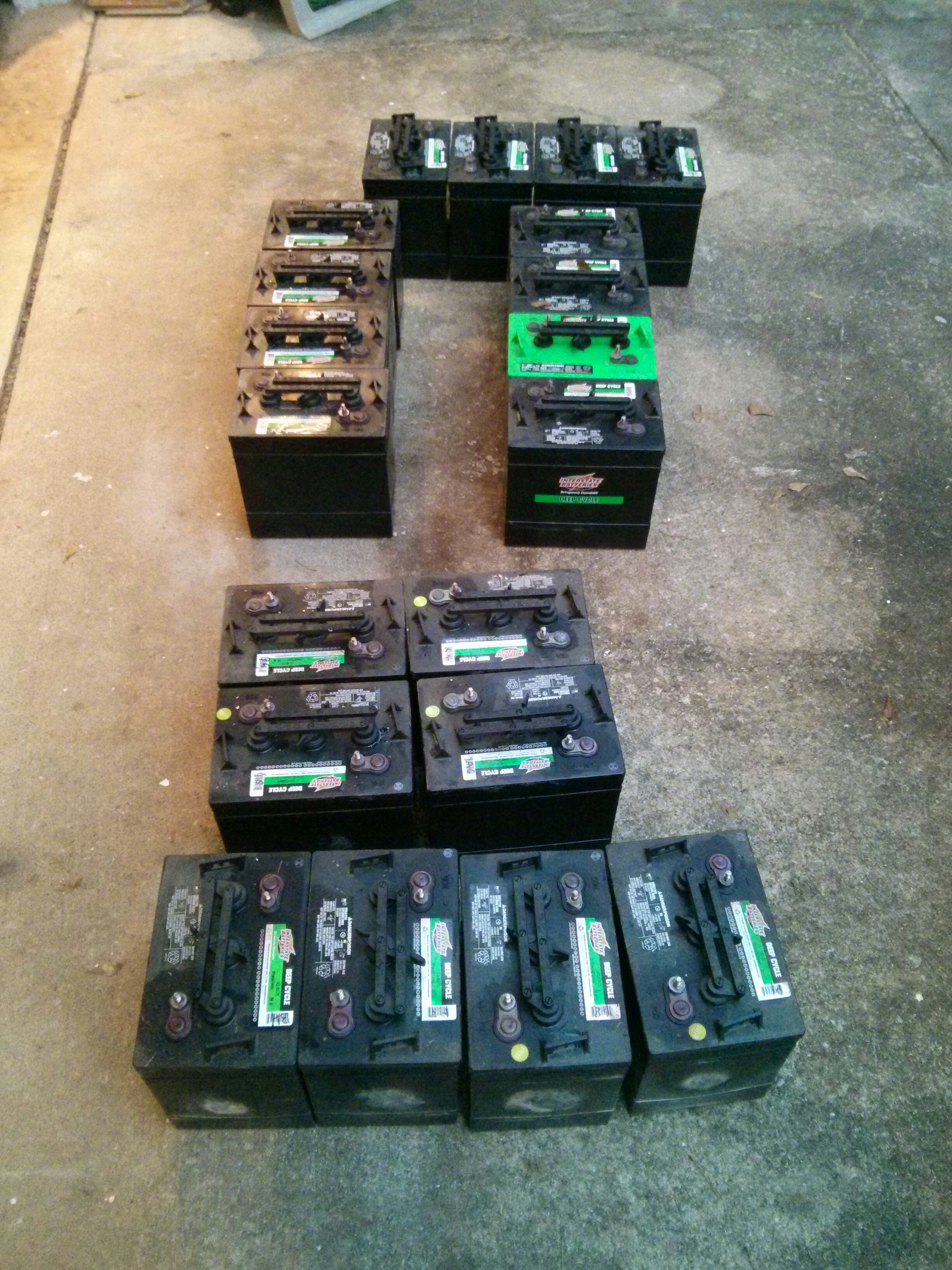
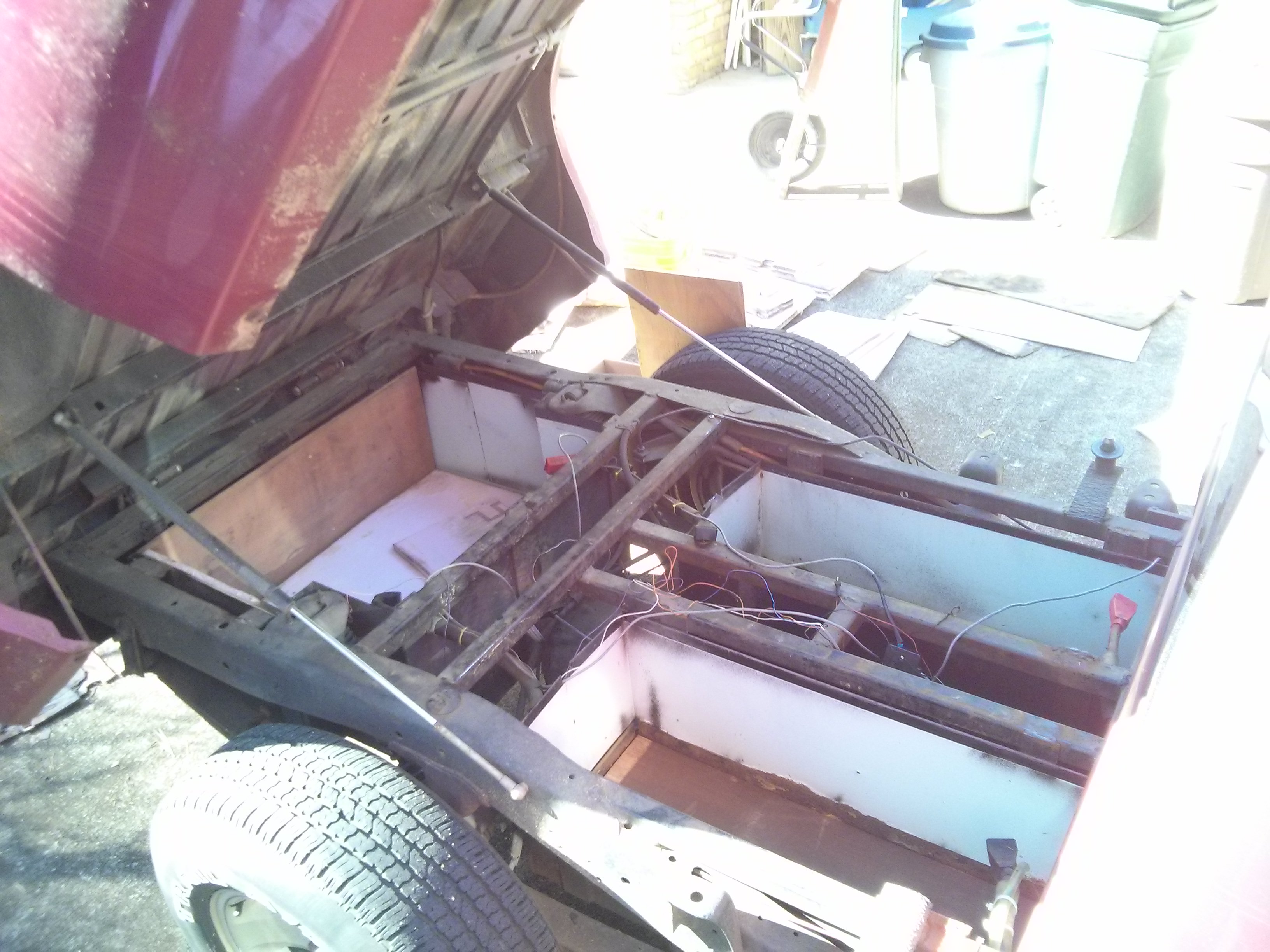
On the first day I removed all twenty of the existing lead acid golf cart batteries. This involved lifting the main piece of wood under the hood that holds the contractors, motor controller, and 12VDC voltage converter, as well as lifting the bed and removing all of my PakTrakr battery monitoring units. After manhandling 1200 lbs of lead out of the truck (only dropping one battery on its side…) I cleaned up the existing battery bays, replacing some rotted wood and dirty foam.
20_golf_cart_batteries
back_bays_empty
empty_front_bay
Continue reading

Nissan Leaf Modules powering my S-10 Pickup conversion

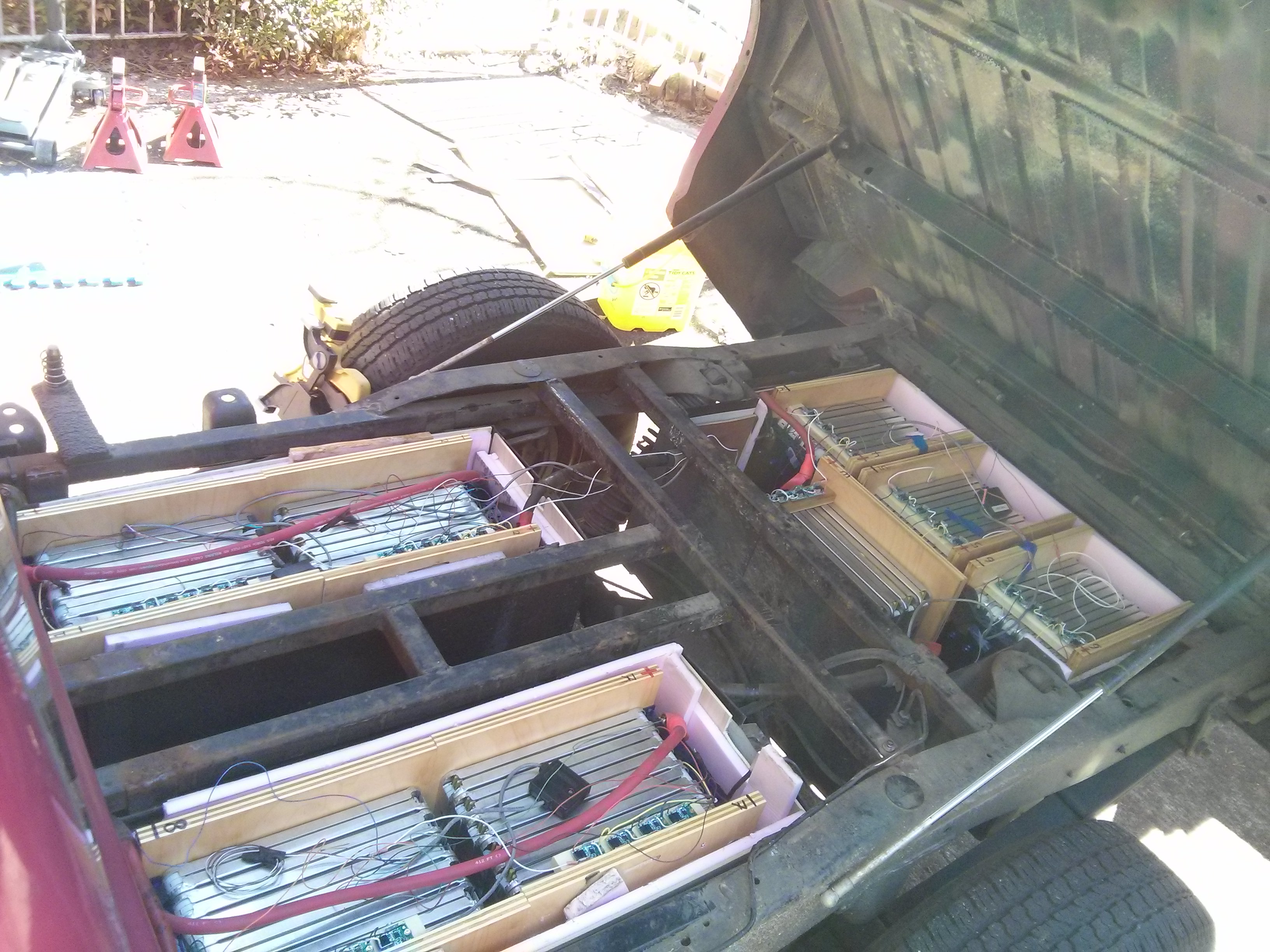
I have successfully driven my S-10 Electric Pickup conversion powered by 48 modules from a salvaged Nissan Leaf battery pack. I have them wired in series, 16 sets of 3 parallel modules, providing 128 volts with 180Ah capacity (23 kWh).

LeafPackInBack

It took me a full three days of work to make the swap and get the truck to a barely drivable condition. I have the cells hooked up with a warning buzzer on the BMS low voltage loop signal, but I do not yet have the charger fully connected. I anticipate another 8 hours of work to get the charger and pakTrakr system fully set up.

Continue reading