Salvage 2013 Nissan Leaf modules – 7 year old range update

Back in January of 2016 I put a set of battery modules harvested from a salvage 2013 Nissan Leaf into my S-10 conversion electric pickup. In march of 2016 I drove the truck for a while to see what its range was. [More than 46 miles, as I got tried of driving. The pack had a capacity of at least 15 kWh at that point in time.]
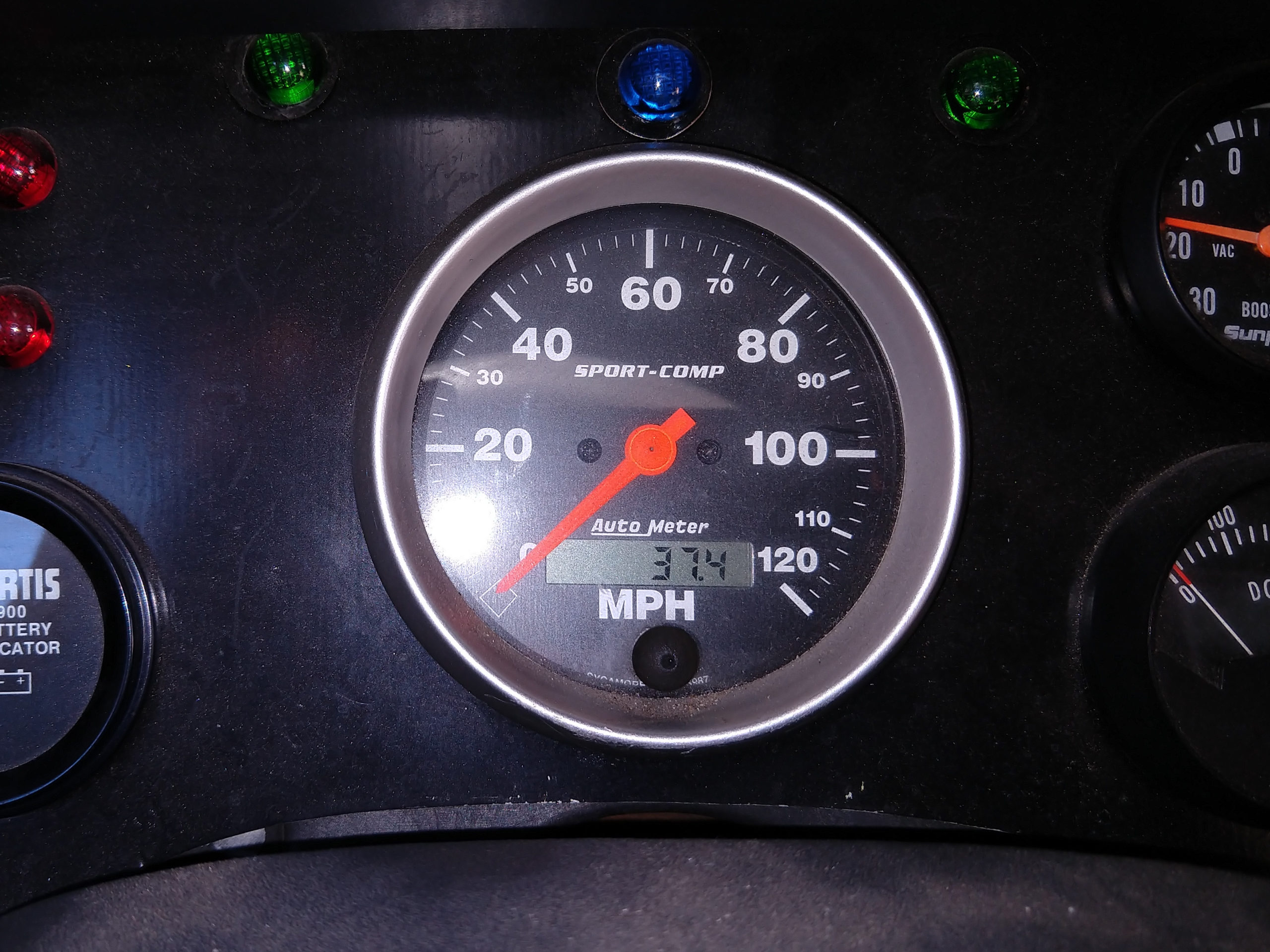
37.4 miles on trip meter.

Today I drove the truck for 35.8 miles before the low cell warning beeper from the BMS started to alert. After I got home [37.4 miles total], the average cell voltage of the pack was 3.75, while my (one) lowest cell was down at 3.3 volts. As it turned out, that cell must have started the trip out at a lower state of charge / voltage from the other cells, as it was still low when charging finished and I had to manually add charge to it individually. [My BMS does a good job of alerting at high/low voltage conditions, but does not do much for balancing the pack.]

According to my JuiceBox, the pack required 14.74 kWh to recharge, which is a good estimate on the battery pack’s current capacity. [This is almost exactly the same amount of power that I used in the trip in 2016, but I didn’t go as far due to different driving conditions. And I also hit the bottom of (at least one cell’s) state of charge.

The 2016 trip averaged 322 watt-hr/mile. This trip consisted of a lot of stop & go city driving as well as a few lengthier stretches of 49 mph arterial streets, and I wasn’t light on the accelerator. My measured watt-hour / mile (from the wall, including charger losses) was: 394 watt-hr/mile

Assuming that the pack has a 15 kWh capacity, this is 63% of the brand new 24 kWh capacity, which means I lost 37 % of the capacity over 7 years. (Some of that was in the original Nissan Leaf, but most of it was in my s-10 conversion.)

I’ll repeat the test after balancing my cells a bit better and see how things go.

Update: I drove the truck until the low cell beeper came on again. I went a total of 38.5 miles, and recharged the pack with 16.69 kWh (16690 watt-hours). The relatively higher   433 watt/hours per mile number is a result of the weather being a lot cooler so I was running the heater in the truck and more 45 mph roads. Balancing the cells got the usable pack capacity (measured from the wall with charging inefficiencies) to 16.69 kWh (which could have theoretically gotten me to 42 miles at 394 watt-hour/mi or 51 miles at 322 watt-hr/mile)

The main take-away is that at 16.5 kWh, I still have access to 68% of the brand new 24 kWh capacity Leaf pack, which isn’t too shabby for a 7 year old battery.



Thermoelectric cooler mark 3.5

I took my version 3 prototype ThermoElectric cooler and removed two of the four TEC modules, bypassing them in the cooling loop, to reduce the power draw.

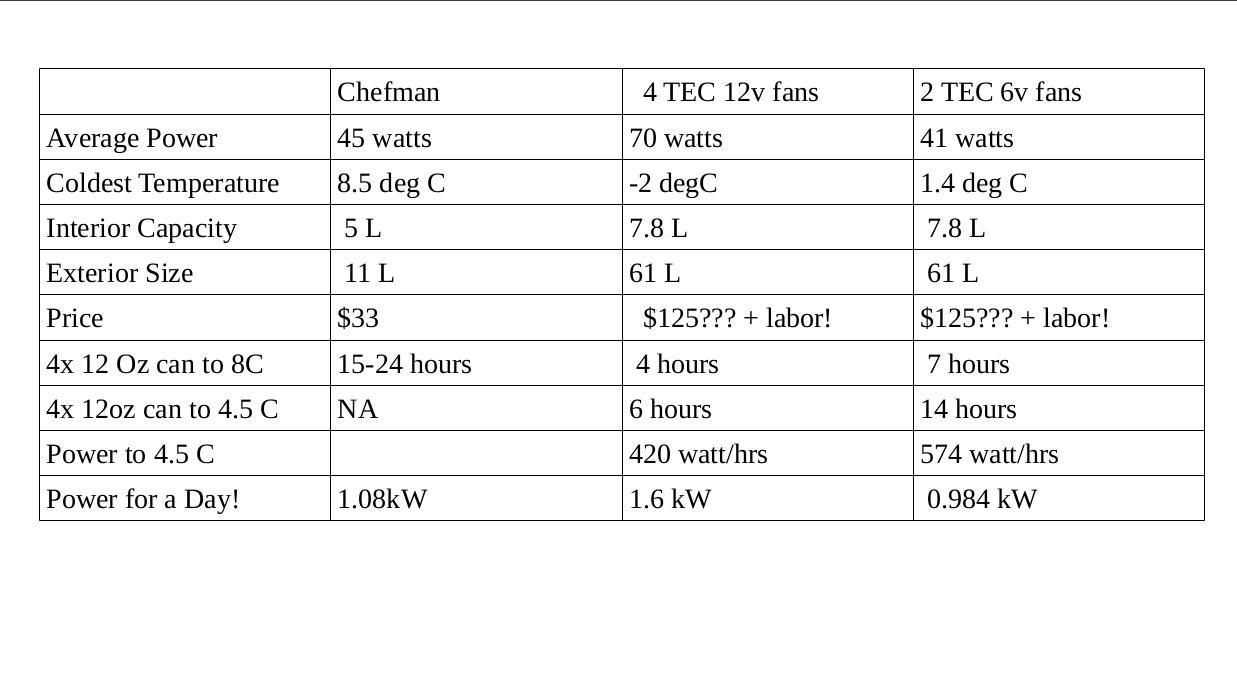
Running two TEC’s at 12v each (in parallel, a sort of “turbo” mode) the whole system draws 136 watts. When I put the TEC’s in series (6v each, or “eco” mode) the whole systems draws 46 watts. This breaks down at 5 watts for the power supply, 11 watts for the fans & pump, and 30 watts for the two TEC’s.

Later on, I also moved the fans to 6v each and reduced the total power draw to 41 watts (the fans went down 5 watts when I reduced their voltage by half).

I’m using a cheap low-efficiency 12v power supply that draws 5 watts all on it’s own just idle, so we could get a 4 watt savings by running if off of a nicer power supply, or a 5 watt savings by running it from a 12v battery directly.

The cooling power is significantly reduced from the 4 TEC version, but I think that having a “turbo/eco” switch that would allow the unit to go from 12v operation on the TEC’s and fans to 6v operation (jumping from 136 watts down to 41 watts) would give the user flexibility to either cool things down when excess power is available, or just maintain temperature when operating off of battery power.   However, even in “eco” mode it takes almost a kWh per day of operation.   But at least it outperforms the Chefman TEC.


Insulation & heat loss of my DIY cooler

My DIY TEC Cooler has an interior volume of 480 cubic inches (6x8x10) and an interior surface area of 376 square inches (2.61 sq ft). It has an exterior volume of 1.55 cubic feet (12x14x16) and an exterior surface area of 1168 square inches (8.11 sq ft).   It generally has 3 layers of 3/4″ poly-iso insulation (R5) plus a small amount of one-part urethane expanding foam (say, R2?) in some areas, for an estimated R 17 insulation value (sorry, I’m using imperial units here as my insulation comes with R values….)

To calculate the amount of heat that will escape from inside my cooler to the outside (the amount of heat loss I need to counteract with the TEC system to maintain a set 34°F temperature on a 77°F day), we need to know the thermal delta between the inside and outside of the fridge.   (I’ll use 34°F for a good refrigeration value, and 77°F for the exterior temperature).

I’ll also use the average value of the interior and exterior surface area ((2.61+8.1) / 2) = 5.36 sq ft for this calculation. As a reminder, the equation to calculate heat loss in BTU/h is:

equation for calculating heat loss in btu/hours

In imperial measurements:
[5.36 * (77-34) ] / 17 = 13.55 BTU/h

13.55 BTU/h   divided by   3.41 = 3.97 watts

Using the SI system with things translated appropriately gives similar numbers:
0.49796 (25-1) / 2.99 = 3.99 watts

Of course, the above numbers may be completely incorrect, so I also did an experiment after building the cooler:

At 4:45pm I placed 3 refrigerated 12oz (355ml) cans of generic Dr. Pepper in my homemade DIY cooler with a temperature of 3.8°C.   [The active TEC elements were turned off, as I was just testing the insulation properties.]

At 4:21am the next day (11 hours 36 minutes later, rounded to 11.5 hours hereafter) I opened the cooler and one can, measuring the interior temperature at 14.6°C. [we’ll assume all three cans gained the same amount of heat…I only wanted to drink one can.]

So, 36 fl oz (1065 ml) of (basically) water gained enough energy to raise its temperature 10.8°C in 11.5 hours. The specific heat of water is 4.184 J/g-K. 1065ml = 1065 grams of water, or just about 1 kg. Nice how that works out.

4.184 J/g-C * 1065 g * 10.8 C = 48124.3680 Jules = 48.124 kJ = 0.0134 kWh = 13.4 Watt/hour

13.4 wh / 11.5 h = 1.1652173913 watts of continuous energy transfer from the outside to the inside of my cooler (heat gain, or cold loss).

You might notice that the calculated 3.9 watts is not equal to the observed 1.16 watts.
The main reason for this is that the interior of my cooler was never at 34 °F. It started at 3.8°C (39°F) and then raised up to 14.6°C (58°F) over 11.5 hours. It spends more time a higher temperatures, as the rate of heat transfer decreases as the thermal delta decreases. [Also, the ambient temperature was closer to 71.6°F, so the difference between the interior and the exterior was significantly smaller than in my previous calculations.]

For example:
[5.36 * (71-39) ] / 17 = 10.09 BTU/h / 3.41 = 2.95 watts
[5.36 * (71-58) ] / 17 = 4.099 BTU/h / 3.41 = 1.20 watts

However, the integration of the above numbers over 11.5 hours would still give me more heat loss than I observed. So either my experimental measures had a flaw, or the R value of my cooler is higher than the estimated 17.

However, as the results are of the right order of magnitude (4 watts vs 1.1 watts), I’m happy with my calculations and the experiment, and feel that the 4   watts of cooling power needed to maintain a 34°F interior temperature is a good upper bound on the performance needed by my TEC system to maintain temperature.

DIY Thermo-Electric Cooler prototype

I have been playing around with building a DIY Thermo-Electric cooler. Yes, I know the TEC’s are horribly inefficient when compared to a compressor based refrigerator. And I know you can buy basic TEC micro-fridges for $20-$50 online.   We have a camping van that has a small odd sized hole that doesn’t quite fit any of the commercially available car/van coolers, so I’m investigating building my own. This post will discuss prototype number 3.

Continue reading

Installing Garage Door Slide Locks

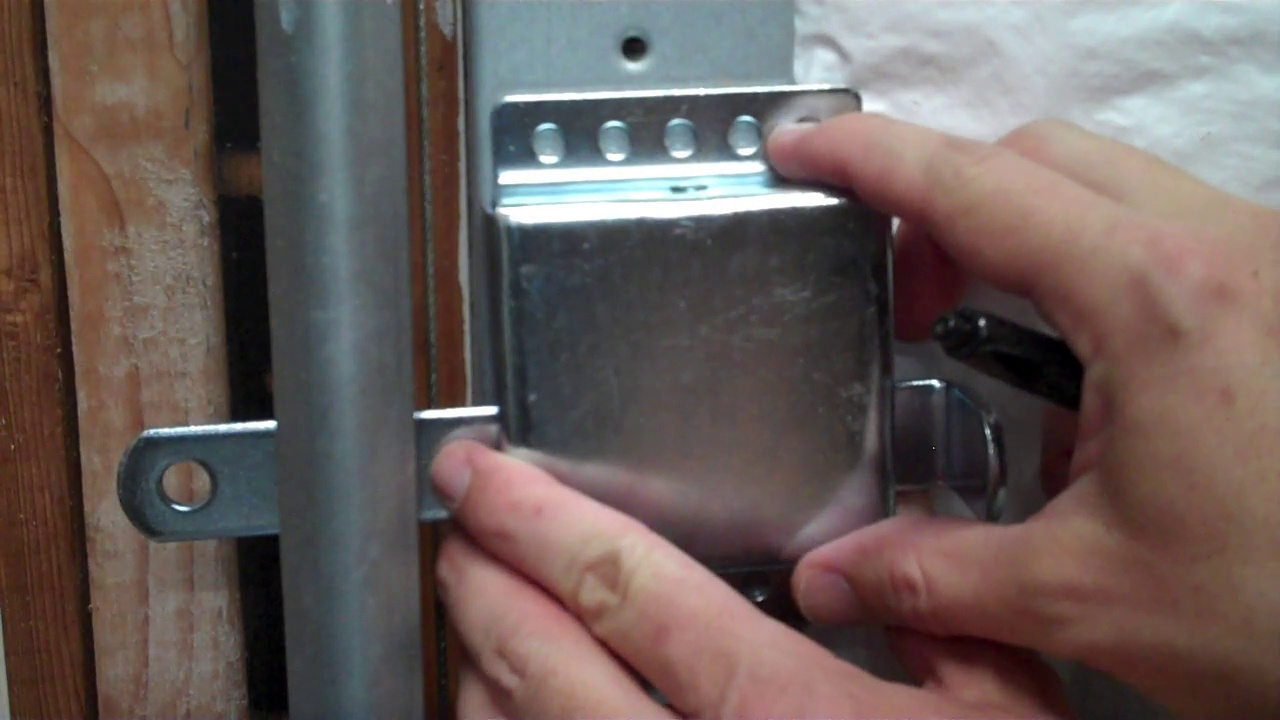
My garage has four doors (two in the front, and two in the back) which gives a lot of cross-ventilation potential, but unfortunately some of the doors had the slide-locks installed incorrectly, such that there was no available slots to lock the doors in a “slightly open” position to let air circulate.   They also only had one lock per door, so I rectified that situation by adding a 2nd slide lock to the other side of each door, and moving a few of the original slide locks so that two of the doors can be locked with a 2″ gap below them.   I spent less than $30 for all four slide locks and a box of self drilling sheet metal screws, so it was a relatively quick and inexpensive improvement.

DIY 4×8 Floating Dock section

My last 8×8 floating dock section was built from mostly salvage materials. I’m slowly adding sections until it reaches shore. Unfortunately, I can’t use the cylindrical foam floats as the base of walkways, as they will rotate/spin in the water. (Also, I have plans for the other 2 cylindrical foam sections….)

Two sections of floating dock on lake

So this 4×8′ section of floating dock uses two commercial roto-molded dock float sections (48x24x16″), which drove the price up to around $680 in materials. (But I have a decent number of composite deck boards and hardware left for the next (3×12′) section I plan on building.   [Yes, every section of my dock will have a different width, deal with it.]


TaoTronics LED Floor Lamp indicator light circuit bend

I bought a TaoTronics LED Floor Lamp from Amazon which has three different color modes (half the LED’s are warm white, the other half are cool white, and you can pick either or both banks together) and allows you to dim the light (which might be needed, as it’s quite bright at full power). Because it uses LEDs, it only draws 10-12 watts for a lot of light output, and you can convert it to a desk lamp just by unscrewing the two extension tubes. Overall I’ve been very happy with it.

The only complaint I had was that the standby indicator light that lights up the power switch to make it easy to find at night was white instead of red, and slightly brighter than I liked. (Most people wouldn’t mind at all, I’m especially sensitive to light at night…)

So I opened the control panel of the lamp by unscrewing four screws in the back and pulling the front piece off. There is a steel C channel that goes from the purple tube screw at the bottom to the gooseneck at the top which I had to take out (3 screws at the top and bottom) to get access to the circuit board.

Continue reading

BEME ERod motor drive unit failures

I have purchased three BEME Erod motorized drape systems (one in a previous house, and two in the current house). They have an infrared (IR) remote control that allows you to open and close the blinds at a push of the button, which is very useful if you have things in front of the blinds that make it hard to access the window, or if you just want to be able to open or close your blinds without getting out of bed.

Two of these units have worked flawlessly for several years. My third unit however has had two separate failures which I suspect may be due to poor quality parts.

The first issue crept up slowly, starting out as an intermittent delay in closing. The blind motor would make a “click” when you pressed the close button, but the motor would not engage for 20-60 seconds. Over time, the delay got longer and longer until eventually the blind refused to close. (Although the relay inside would still click when the button on the remote was pressed.)

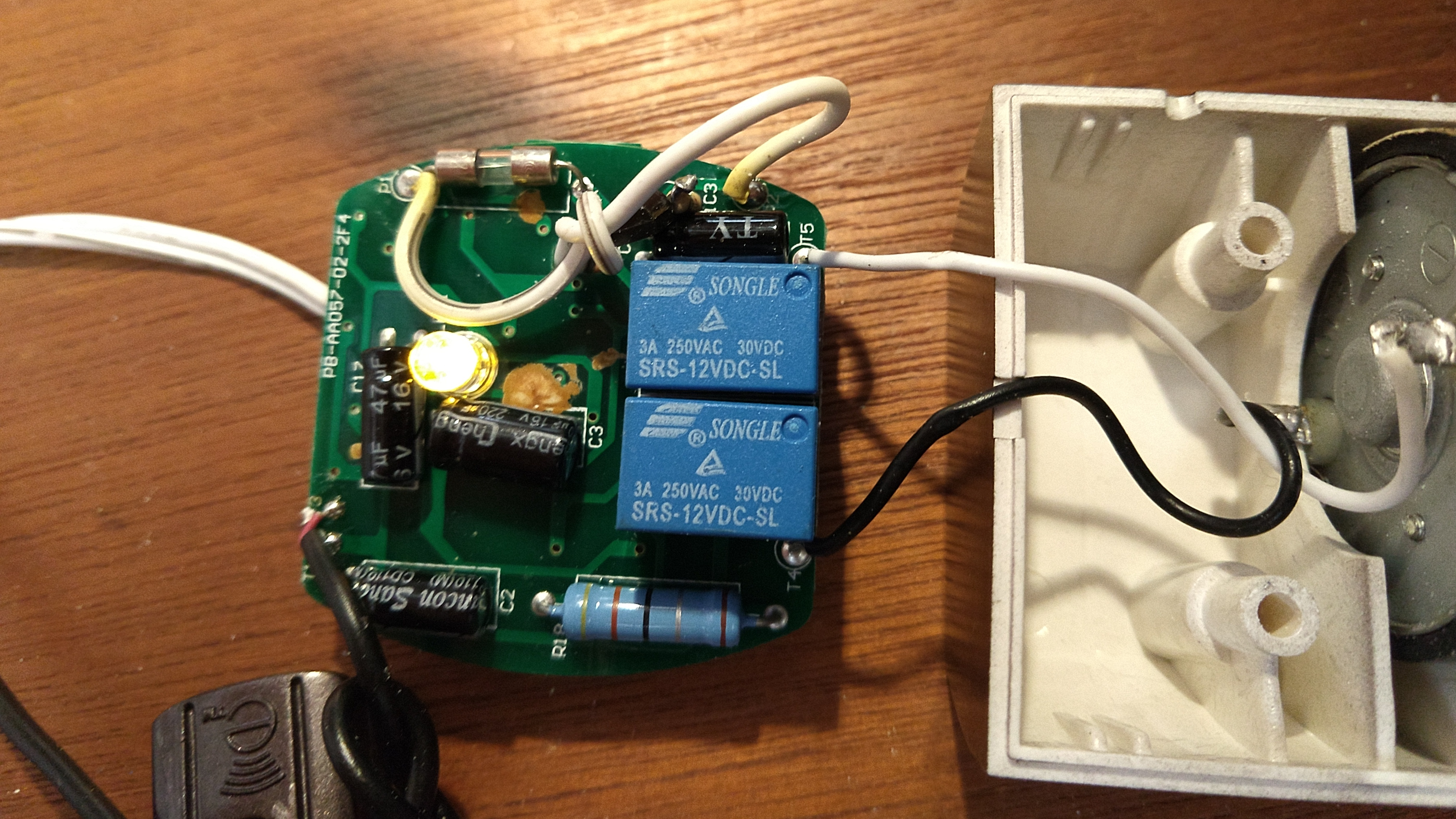
Diagnosing this as a relay contact failure just from the sounds it made, I opened up the unit, found the part number on the relays, ordered replacements and (for good measure) replaced both relays. (I bought 5 of the relays, so I’m all stocked up for future relay failures.)
two blue relays on a circuit board.

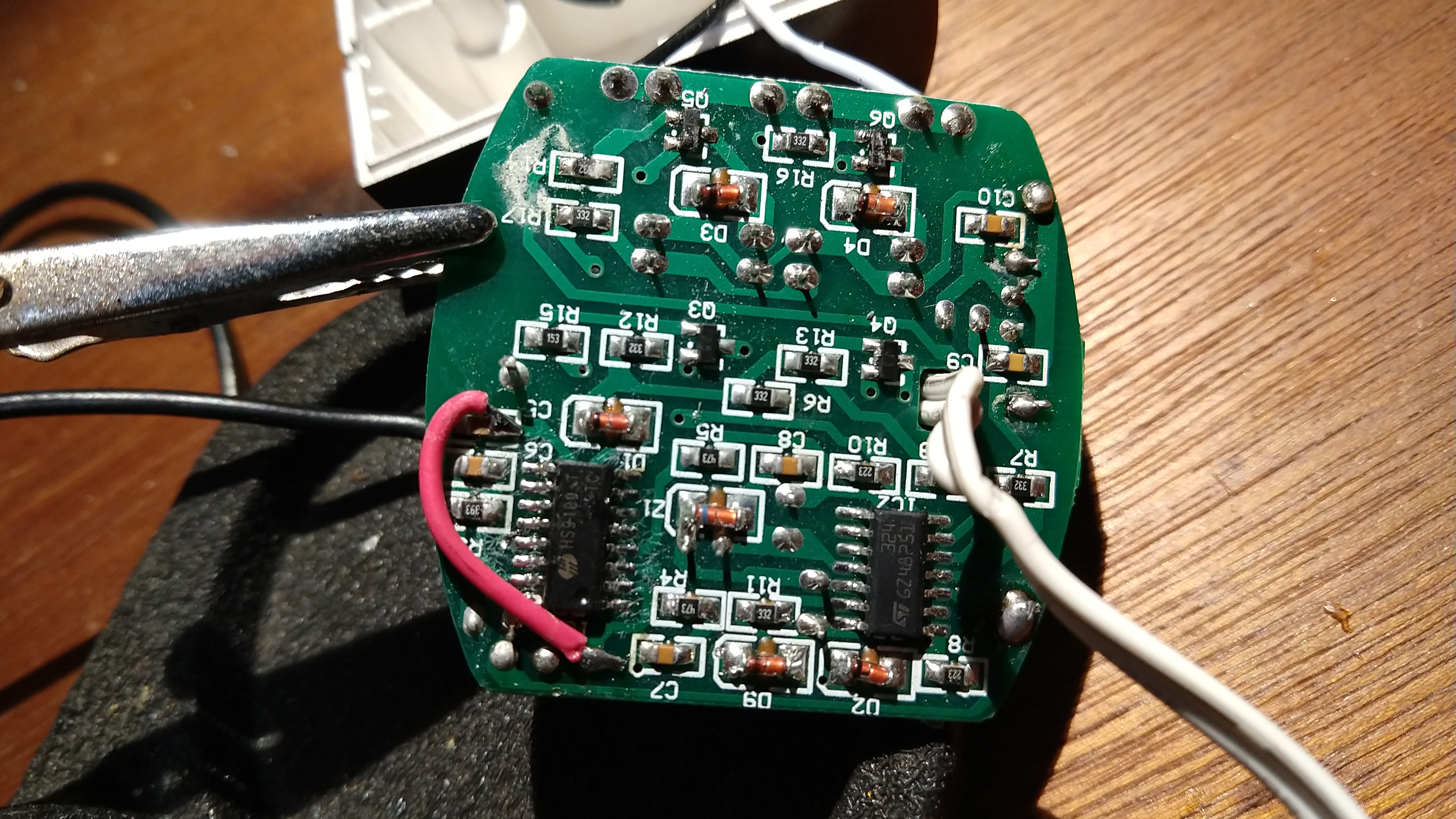
When I had the unit open, I noticed that there was one extra red “re-work” wire on the circuit board, indicating that the PCB had a problem (either a trace left out of the design, or not correctly connected on the PCB during manufacture.) and had to be repaired at the time of manufacture. This is actually more common than you might expect on inexpensive consumer goods, and since the motor was working well with the new relays, I closed things back up.

Around six months later, one night with no prior warning, the motor failed to respond to the remote control completely. No clicking, so the problem probably wasn’t the relays.

Here was my diagnosis procedure:

  • I tried the remote on my other erod (despite the fact that the red light was lighting up when I pushed the buttons) to make sure the remote was working.
  • Because the motor unit was acting as if it was not receiving any power (completely dead), I took the power adapter and tested to make sure it was providing power by using it on my other (working) erod.
  • Now that I had determined that the problem was definitely with the motor unit, and not with the power supply or remote, I disassembled the motor unit.
  • I checked the fuse on the circuit board, as it is the first possible reason power might not get into the circuit, but it was fine. (Also, a small yellow LED on the circuit board was dimly illuminated when plugged in.)
  • I visually checked the capacitors to make sure that none of them were leaking.
  • Since I had a diode tester mode on my multimeter, I checked all the diodes (but didn’t really expect them to have failed….)
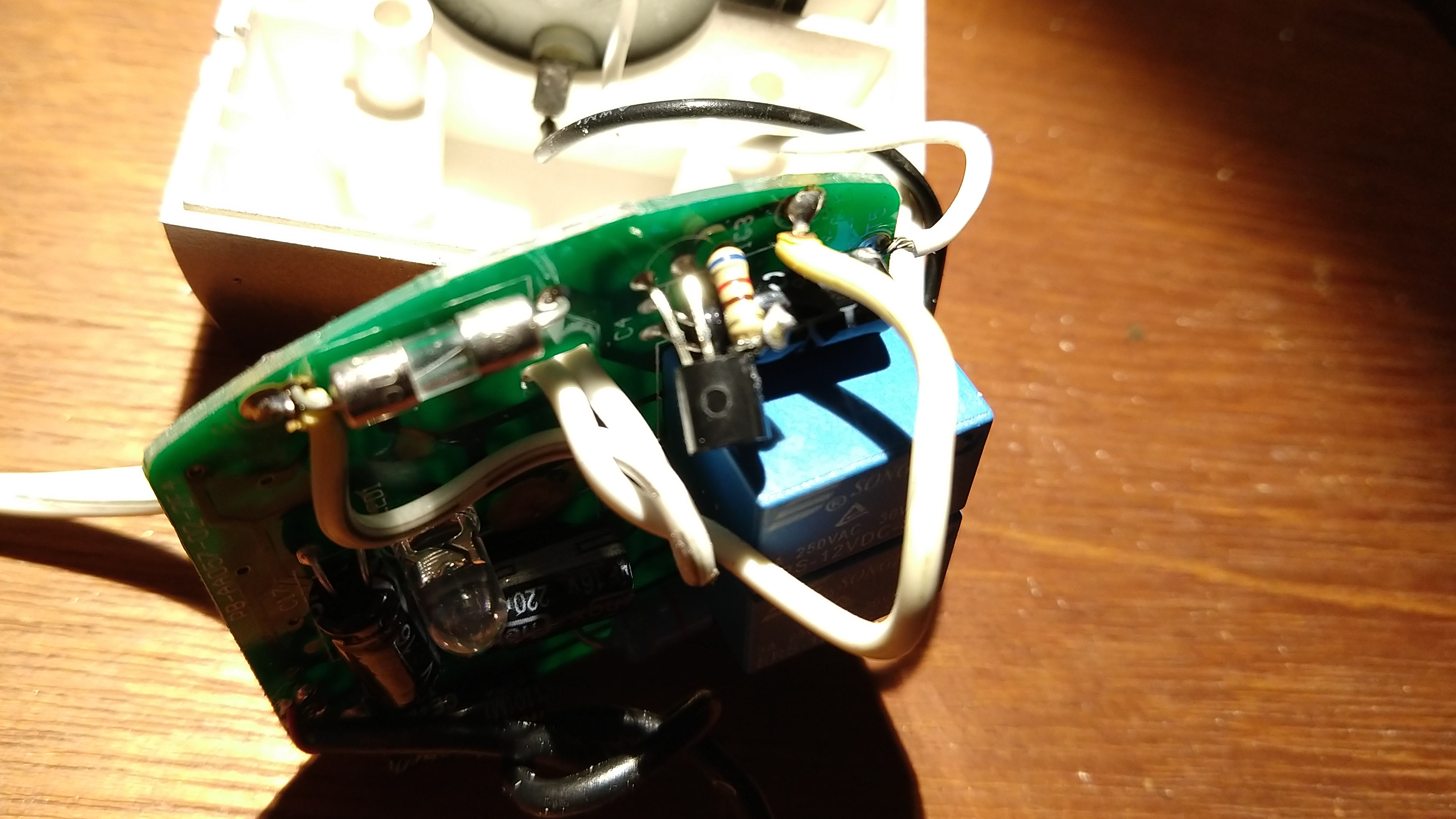
  • At this point, I noticed something funky on the circuit board. A small black component had one of it’s legs replaced by a resistor.   (You’ll probably have to zoom into the photo to see it.) Normally, if a resistor is called for in a circuit, it will have its own location on the circuit board. This resistor was definitely added in later in the manufacturing process, and was not part of the original circuit board design.   Since I hadn’t found anything else that would explain the failure, I felt that investigating this part was a good idea.

78L05 power regulator with a resistor replacing it's input leg

  • The part is a 78L05 linear power regulator, which steps the 12v input down to   5 volts suitable for powering the microchips that watch for the IR remote control signal and trigger the relays (via transistors).   The small yellow led was illuminating on the board when power was applied, so the 5 volt power rail should be working….but, the whole resistor leg looked dodgy to me. When I measured the voltage coming out of the 78L05 regulator, it was only 2.7 volts!   (Just enough to illuminate the LED dimly, but not enough to run the other ICs.) After looking up the spec sheet to make sure that it wasn’t a 3.3 volt regulator, and really was supposed to be outputting 5 volts, I knew that either the power regulator was faulty, or something farther into the circuit was drawing so much power that it was not able to provide the proper voltage.
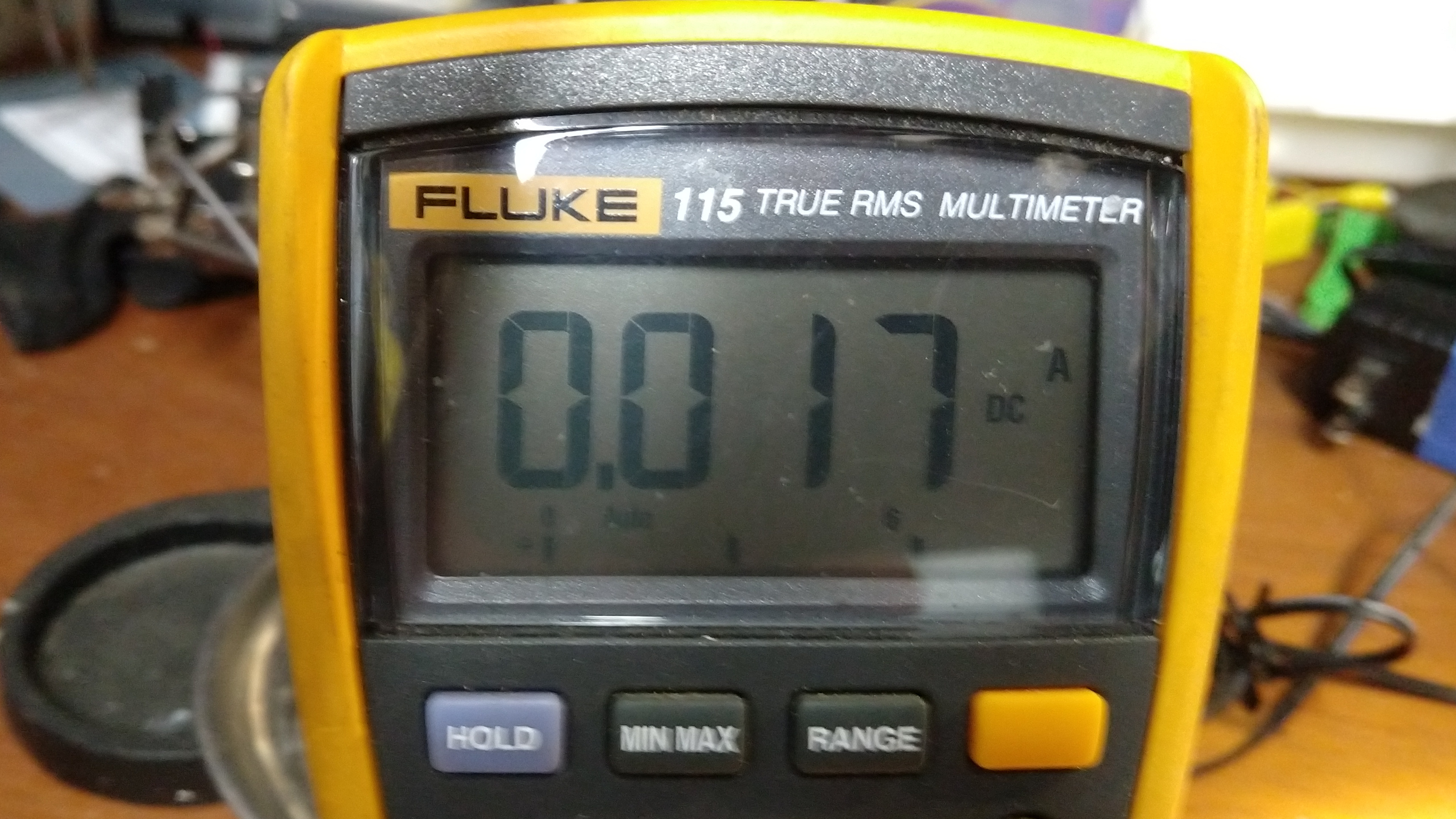
  • I de-soldered the output leg of the power regulator from the rest of the circuit, and the output voltage went up to 5 volts, which hinted that the problem might be farther into the circuit. However, when I tested how much power the regulator could provide, it would only drive 17mA into a short! (A good regulator should provide 100 or 150 mA of power.)

  • I wasn’t sure if the resistor on the input leg was limiting the current that much, so I took the whole thing out and tried powering the regulator directly by bypassing the resistor, and it had the same low output current issue.
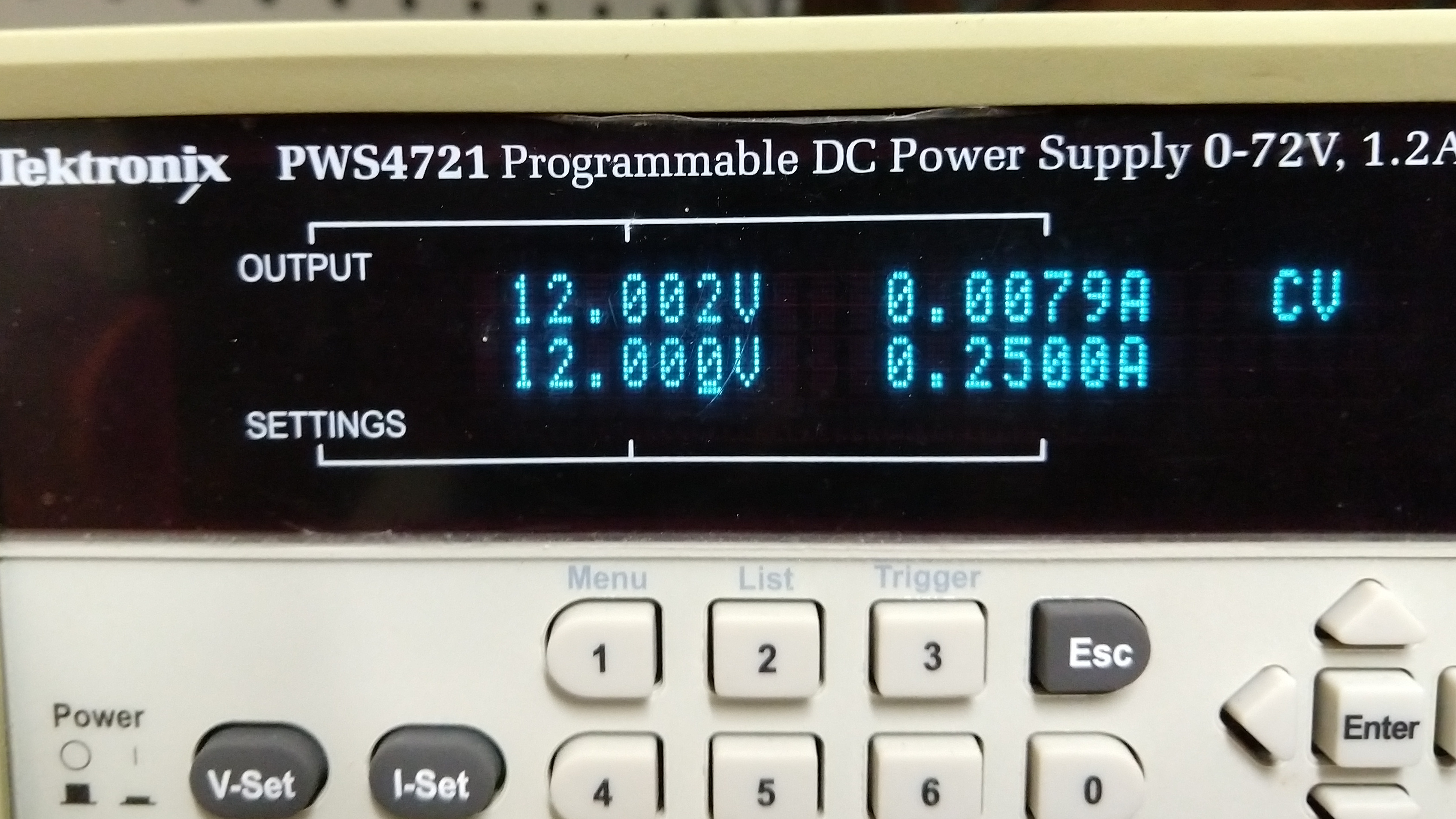
  • So, time for a new 78L05 power regulator. This is a VERY common 5 volt regulator, and I happened to have one in-stock, which I soldered back into the circuit. I considered leaving in the input resistor (520 ohm), but decided against it, as the original circuit schematic obviously didn’t have that part, and according to the spec sheet, a 78L05 should be able to go from 12v down to 5v without problems. I measured the idle current draw of the entire motor unit afterwards, and it was only 8 mA, so the voltage regulator is dissipating 12-5 = 7 volts at 8mA, or 0.056 watts (5.6 mWatt) continuously, which is trivial even without a heatsink.

My suspicion is that the factory substituted an “off-brand” (or even counterfeit) 78L05 power regulator which they knew would have trouble dropping 7 volts, so they put a resistor in front of it to drop some of the voltage/power external to the power regulator, but the cheap part still failed.   I’m hopeful that I have now replaced all of the parts that are likely to fail in this unit, and perhaps it will work well for me in the future.